Gropweb123
News Update
Loading...

السبت، 2 أبريل 2022

The problem isn’t the number of EV chargers, it’s where they are

The problem isn’t the number of EV chargers, it’s where they are

The problem isn’t the number of EV chargers, it’s where they are 

We’re constantly hearing there’s a lack of EV charging infrastructure — especially if we are going to meet the demand for all-electric vehicles in the next few decades. But what if the problem isn’t just the number of EV chargers, but their location as well?


I recently met with Rohan Puri, CEO and co-founder of Stable Auto, a company that uses data science and location intelligence to determine the best site for EV chargers.


Based on data from thousands of points, the reality is most chargers are used less than 10% of the time, and very few over 20%. Particularly problematic are fast chargers. Puri explained:


The US has over 17,000 public DC fast chargers, most of which with shockingly low utilization. Some are never used, while others have wait lines.


EV charging usage patterns But an EV charging company needs at least 15% usage to break even. And traditionally, chargers are placed in the areas cheapest and easiest to get a permit. These are not always the most profitable locations. 


Effective placement increases usage and profits

Where to place an EV charger

An example of the kind of data Stable can provide. Credit: Stable

The company has developed a proprietary machine learning model to predict and categorize site utilization to a high degree of accuracy. 


It uses 70 different data points, including income levels, time of day traffic, nearby amenities, local competition, the number and speed of current EV chargers in the area, and the growth of EV adoption.


Stable Auto is currently working with major utility providers, charging networks, sites, and operators across the US. It allows them to gauge new locations against millions of charging events, test real build-out scenarios, understand potential trade-offs, and bolster their business case with a higher score.


This data is also relevant to the government, investors and banks that underwrite and fund EV charging infrastructure. 


An opportunity to incentivize EV charging in low-income areas

Detroit EV charging

Stable’s Site Score analysis reveals a blueprint for deploying EV chargers in Detroit. Shaded regions show low (red) and high (green) unmet demand for EV charging, compared to the location of public EV chargers today (icons). Credit: Stable

The statistics also create a means to introduce equity charging to incentivize lower costs or subsidized chargers in places where use is traditionally low. 


Stable Auto used its Site Score product to analyze public charging station placement. Purl noted that most EV charger placements serve and prioritize high-income areas. So, the ability to show where there are opportunities to increase equitable access and foster EV adoption is a valuable way to support EV adoption.


EVs are set to become mainstream in the next couple of decades. Public charging will never be as simple as that enjoyed by those charging at home. But Stable is helping make it a lot easier. 

Here’s why bitcoin miners won’t go for a more climate-friendly alternative

Here’s why bitcoin miners won’t go for a more climate-friendly alternative

Here’s why bitcoin miners won’t go for a more climate-friendly alternative 

Fewer and fewer people are using bitcoin for digital payments. Nevertheless, bitcoin transactions are consuming more energy than ever before – the same amount as the whole of Thailand. With a carbon footprint equivalent to the Czech Republic’s (around 114 million tonnes per year), bitcoin is canceling out other climate wins.


The global take-up of electric vehicles, for example, is estimated to have prevented 50 million tonnes of CO₂ so far. That’s less than half of bitcoin’s emissions for a single year. And the problem’s getting worse. The growth of bitcoin “mining” powered by fossil fuels is outpacing greener alternatives, causing bitcoin’s carbon footprint to swell five-fold in just two years.


But, according to campaign groups Greenpeace and the Environmental Working Group, all this can be easily fixed with a simple update to bitcoin’s software. Their campaign, called Change the Code Not the Climate, launched recently and calls on bitcoin software developers to switch the network from its currently wasteful system for verifying transactions to a more climate-friendly alternative.The switch, they claim, would reduce bitcoin’s carbon footprint by 99.9%. But it’s unlikely to happen soon – and here’s why.


Proof of waste to proof of stake?

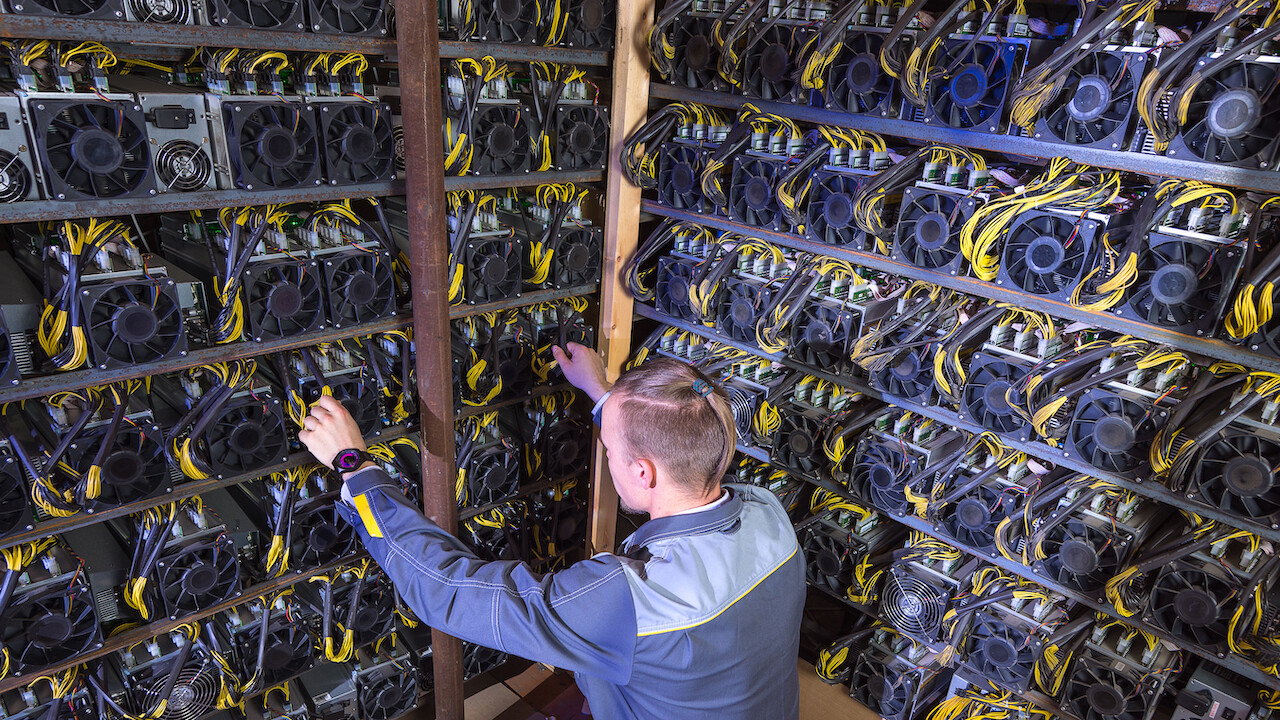
Bitcoiners don’t trust bankers, taxmen and other meddling middlemen. Because there are no banks with bitcoin, the job of keeping the books straight is given to a global network of specialist computers. The owners of these computers compete for bookkeeping tasks in return for the transaction fees paid by network users. They also get a few newly minted bitcoins as a thank you.


This competition is known as Proof of Work (PoW) mining. It works like an ever-expanding game of hungry hippos. The more players that join the contest, the more work each hippo needs to do in order to win anything. If a new hippo with green intentions joins the game, everyone at the table has to work harder. Players powered by coal in Kazakhstan, or fossil gas in Texas, then belch out extra smog.


The higher the bitcoin price, the more the dirty hippos are prepared to waste on coal and gas until their costs for doing so are equal to their reward. And so, Proof of Work is proof of waste. And this is waste by design: Bitcoiners call this inefficiency “the feature, not the bug”.


Greenpeace hopes the bitcoin community could learn to love Proof of Stake (PoS) instead. With the network running on PoS, bitcoin’s bookkeepers would need to stake a prescribed minimum number of bitcoins as a security deposit. If they validate fraudulent transactions, they lose their stake. This disincentive keeps the network secure.


A number of blockchains, including Cardano, EOS, and TRON already use a PoS system, where token holders vote for the most qualified block producers. While bitcoin currently uses millions of mining computers, these PoS networks usually maintain an assembly of around 20 machines using a comparably minuscule amount of energy, taking turns to receive bookkeeping rights.


Code blockers

For bitcoin, coding these changes would be straightforward. Greenpeace claims that only 30 people – the largest mining outfits, exchanges like Coinbase and Binance, and code developers – would need to agree the switch to PoS.


But this ignores the fact that everyone would need to run the upgraded software. On average, to successfully mine bitcoin once per week requires shelling out around US$1.8 million (£1.4 million) on hardware. Most miners are protective of these investments and conservative when it comes to amending the software code that underwrites their winnings.


For this reason, Chris Bendiksen, a commentator at the cryptocurrency website CoinShares, puts the chance of Bitcoin ever moving to PoS at 0%. “There is no appetite among Bitcoiners to destroy the security of the protocol by making such a move”, he says.


Bitcoin is no stranger to coding stalemates. An amendment to fix intermittent congestion issues and stabilize transaction fees was proposed in 2016. Despite being a relatively simple fix, the change split the bitcoin community, with the vast majority continuing to support the slower, more expensive status quo.


Even if some users were prepared to ditch PoW, the original bitcoin network would continue in some form. This PoW version would keep the name, branding, super-rich disciples, and polluting PoW miners. The PoS offshoot could end up as just another disappointing experiment.


Another PoW heavyweight network, Ethereum, has been promising a shift to PoS since birth. But this migration has remained just around the corner for several years.


Starting a PoS network from scratch is another option. But there is already a BitcoinPoS cryptocurrency. Aside from an early flurry of interest, it’s attracted few supporters.


Tackling crypto greenwashing

Many Bitcoiners scoffed at the Greenpeace campaign. After all, much of the funding for this marketing mission comes from billionaire venture capitalist Chris Larsen, co-founder of rival cryptocurrency Ripple.


Larsen’s Ripple was also an original member of the UN-backed Crypto Climate Accord, an organization convened in April 2021 to promote more sustainable cryptocurrency trading. In response, prominent bitcoin advocates established the Bitcoin Mining Council – a public relations group aiming to “defend bitcoin against uninformed and hostile energy critics”, like Larsen.


Some argue that governments in Europe and North America should follow China’s lead and ban PoW mining.


Retaliatory campaigns from bitcoin advocates are ramping up, and their greenwashing appears to be winning. The European Parliament recently rejected a bill to ban PoW mining across the EU. The UK government also fears an exodus of crypto trading talent for other financial centers.


Research I have led suggests that effective regulation of bitcoin will not come from charity appeals. A globally coordinated ban, led by governments, is likely to prove the most effective solution.

Google launches Play Store’s new billing system — and devs are footing the bill

Google launches Play Store’s new billing system — and devs are footing the bill

Google launches Play Store’s new billing system — and devs are footing the bill 

Google Play’s new billing payment system policy starts today. This change forces developers to use the company’s own payment system for in-app purchases.


The update means that you can’t add links or sections in the app that redirect users to buy premium subscriptions from your site or alternative sources. In turn, you will have to pay a 15% or 30% fee (depending on your app’s category) to the search giant for facilitating these transactions.


Google first announced this in September 2020, giving developers a one-year window to make changes to their apps so Google Play Billing was the default payment system. Last year, it gave a six-month extension to some developers, extending the deadline date to March 31, 2022.From today, the company’s new policy takes effect for everyone — and things are changing. For instance, if you’re using alternative payment methods, you can’t promote your plans on the app, or create links that’ll take users to that page.


Currently, Spotify has a premium section listed on its Android app that redirects users to its website. Technically, it has to remove this section from its app. But since it has struck a deal with Google to test out alternative billing methods, it might get a pass.


Spotify's Android App has links to its website to buy premium subscriptions.

Spotify’s Android App has links to its website to buy premium subscriptions.

You can read about the conditions on this page.


If your app fails to comply with Google’s policy by June 1, 2022, it’ll be removed from the Play Store.


Although, this isn’t the case everywhere in the world.


For developers in India, Google’s giving them until October 2022 to make the shift. But that could change as earlier this week, the Competition Comission of India (CCI) found the Big G’s billing conditions “unfair” and “discriminatory.”


Last year, South Korea passed a law to force Apple and Google to allow developers to include alternative payment methods in their apps. Google has complied with this, and will take an 11% cut if an app uses a third-party method.


Plenty of people are still angry at Google for how it distributes apps on the Play Store. Earlier this week, Epic Games criticized the company and said, “One deal does not change the anti-competitive status quo.”


ADIF (Alliance of Digital India Foundation), an industry body of the country’s startups, said it’s unfair that developers will have to pay commission fees, and mandatorily use Google’s system:


With their measures and announcements, Google is trying to create an illusion of choice. We at ADIF urge for an extension of choice to all apps and an immediate extension of the March 31 deadline for all.

Here’s a list of weird subreddits to ruin your day

Here’s a list of weird subreddits to ruin your day

Here’s a list of weird subreddits to ruin your day 

My favorite thing about the internet is that everybody can find like-minded people. No matter how niche your hobby, or how obscure your kink, there’s a community out there for you.


The logical consequence of that is shit on the web gets real weird, real fast. I’m not judging — it is, in fact, my second favorite thing about the internet.


The hub of a lot of the internet’s weirdness is, obviously, Reddit. Its sprawling ecosystem of subreddits is a beautiful reflection of the human condition. And of the fact that we really love memes about the Star Wars prequels.Since I spend a disturbing amount of time on the platform, I have seen things. And now, so will you. Here’s a few of the weirdest subreddits out there.


r/imsorryjon

What do you get when you mash up Garfield and cosmic horror? A great time. It’s not often that we see a character making the jump from loveable comic character to interdimensional dread lord, and I am here for it.

Screenshot of r/imsorryjon


r/longfurbies

How do you improve what’s already perfect? By making it longer.


Screenshot of r/longfurbies


r/breadstapledtotrees

What are you looking at me for? It says it right on the tin.


Screenshot of r/breadstapledtotrees


r/subredditsimulator

One of my favorites. r/subredditsimulator is a completely non-participatory subreddit that is only meant to be watched. On it, bots create posts and comments, based on stuff they observe on other subreddits. The result is a very accurate, but completely nonsensical mirror-universe of Reddit.

Screenshot of r/subredditsimulator


r/amish

Get it?


r/desirepath

Not as out there as some of the others on this list, but weirdly interesting. As the description says: “Dedicated to the paths that humans prefer, rather than the paths that humans create.”


Screenshot of r/desirepath


r/farpeoplehate

A subreddit dedicated to hating on people that are far away. Because fuck those folks.


r/pocketsand

A group of people casually discussing the advantages of carrying around sand in your pockets. For self defence.


Screenshot of r/pocketsand


r/Ooer

The mother of all weird subreddits. Unknowable content, a lay-out that makes your eyes bleed, and a comment section that reads like a fever dream. It is everything, and nothing. It is r/Ooer.


Screenshot of r/ooer


Got some weird subreddits of your own to share? Hit us up on Twitter.

You suck at Googling: 5 tips to improve your search skills

You suck at Googling: 5 tips to improve your search skills

You suck at Googling: 5 tips to improve your search skills 

I was recently reading comments on a post related to COVID-19, and saw a reply I would classify as misinformation, bordering on conspiracy. I couldn’t help but ask the commenter for evidence.


Their response came with some web links and “do your own research”. I then asked about their research methodology, which turned out to be searching for specific terms on Google.


As an academic, I was intrigued. Academic research aims to establish the truth of a phenomenon based on evidence, analysis , and peer review.On the other hand, a search on Google provides links with content written by known or unknown authors, who may or may not have knowledge in that area, based on a ranking system that either follows the preferences of the user, or the collective popularity of certain sites.


In other words, Google’s algorithms can penalize the truth for not being popular.


Google Search’s ranking system has a fraction of a second to sort through hundreds of billions of web pages, and index them to find the most relevant and (ideally) useful information.


Somewhere along the way, mistakes get made. And it’ll be a while before these algorithms become foolproof – if ever. Until then, what can you do to make sure you’re not getting the short end of the stick?


One question, millions of answers

There are around 201 known factors on which a website is analyzed and ranked by Google’s algorithms. Some of the main ones are:


the specific keywords used in the search

the meaning of the keywords

the relevance of the web page, as assessed by the ranking algorithm

the “quality” of the contents

the usability of the web page

and user-specific factors such as their location and profiling data taken from connected Google products, including Gmail, YouTube and Google Maps.

Research has shown users pay more attention to higher-ranked results on the first page. And there are known ways to ensure a website makes it to the first page.


One of these is “search engine optimization”, which can help a web page float into the top results even if its content isn’t necessarily quality.


The other issue is Google Search results are different for different people, sometimes even if they have the exact same search query.


Results are tailored to the user conducting the search. In his book The Filter Bubble, Eli Pariser points out the dangers of this – especially when the topic is of a controversial nature.


Personalized search results create alternate versions of the flow of information. Users receive more of what they’ve already engaged with (which is likely also what they already believe).


This leads to a dangerous cycle which can further polarise people’s views, and in which more searching doesn’t necessarily mean getting closer to the truth.


A work in progress

While Google Search is a brilliant search engine, it’s also a work in progress. Google is continuously addressing various issues related to its performance.


One major challenge relates to societal biases concerning race and gender. For example, searching Google Images for “truck driver” or “president” returns images of mostly men, whereas “model” and “teacher” return images of mostly women.


While the results may represent what has historically been true (such as in the case of male presidents), this isn’t always the same as what is currently true – let alone representative of the world we wish to live in.


Some years ago, Google reportedly had to block its image recognition algorithms from identifying “gorillas”, after they began classifying images of black people with the term.


Another issue highlighted by health practitioners relates to people self-diagnosing based on symptoms. It’s estimated about 40% of Australians search online for self-diagnosis, and there are about 70,000 health-related searches conducted on Google each minute.


There can be serious repercussions for those who incorrectly interpret information found through “Dr Google” – not to mention what this means in the midst of a pandemic.


Google has delivered a plethora of COVID misinformation related to unregistered medicines, fake cures, mask effectiveness, contact tracing, lockdowns and, of course, vaccines.


According to one study, an estimated 6,000 hospitalizations and 800 deaths during the first few months of the pandemic were attributable to misinformation (specifically the false claim that drinking methanol can cure COVID).


To combat this, Google eventually prioritised authoritative sources in its search results. But there’s only so much Google can do.


We each have a responsibility to make sure we’re thinking critically about the information we come across. What can you do to make sure you’re asking Google the best question for the answer you need?


How to Google smarter

In summary, a Google Search user must be aware of the following facts:


Google Search will bring you the top-ranked web pages which are also the most relevant to your search terms. Your results will be as good as your terms, so always consider context and how the inclusion of certain terms might affect the result.

You’re better off starting with a simple search, and adding more descriptive terms later. For instance, which of the following do you think is a more effective question: “will hydroxychloroquine help cure my COVID?” or “what is hydroxychloroquine used for?”

Quality content comes from verified (or verifiable) sources. While scouring through results, look at the individual URLs and think about whether that source holds much authority (for instance, is it a government website?). Continue this process once you’re on the page, too, always checking for author credentials and information sources.

Google may personalize your results based on your previous search history, current location, and interests (gleaned through other products such as Gmail, YouTube or Maps). You can use incognito mode to prevent these factors from impacting your search results.

Google Search isn’t the only option. And you don’t just have to leave your reading to the discretion of its algorithms. There are several other search engines available, including Bing, Yahoo, Baidu, DuckDuckGo and Ecosia. Sometimes it’s good to triangulate your results from outside the filter bubble.

Germany sticks it to Russia by offering a €9 monthly public transport ticket

Germany sticks it to Russia by offering a €9 monthly public transport ticket

Germany sticks it to Russia by offering a €9 monthly public transport ticket
In an effort to reduce its reliance on Russian oil, the German government is slashing the cost of public transport for residents. 

In summer 2022, people living in Germany can get a monthly public transport ticket for only €9 euros per month — a tenth of its usual price. The ticket will be offered for three months and will be called “9 for 90”.

price cuts BVG 
Heavily subsidized tickets are planned to get Berliners using public transport.
The move is in response to rising energy and fuel prices caused by the Ukraine war. The German government wants to halve its Russian oil imports by June.According to Al Jazeera, before the war began on February 24, a third of Germany’s oil imports, 45% of its coal purchases, and 55% of gas imports came from Russia.

Economy Minister Robert Habeck wants to be “almost independent” of Russian oil by the end of 2022. 

Will cheap tickets mean greater public transport use?
 

public transport in Berlin 
Berlin public transport is well supported by the urban population. Credit: BVG
It’s unclear how much impact the subsidized public transport will have on car ownership or usage. 

It’s likely to lead to more people purchasing the low-cost tickets. But this doesn’t necessarily translate to more people abandoning their cars for a trip by train, tram, or bus. 

Or that people will continue using public transport once the summer ends — no one likes waiting in the cold for a bus.

Further, while the city of Berlin and other major cities like Hamburg and Frankfurt are well serviced by public transport, this is unsurprisingly not the case in rural Germany, where 90% of households own at least one car. 

Low population density in rural areas limits the access and frequency of public transport. It also limits the development of bike paths and any last-mile solutions.

A survey earlier this year found that 75% of German households who regularly use their car are willing to switch to public transport. 66% could imagine taking their bike more often. The survey further revealed that rural folks are almost equally as willing to take a bicycle as city dwellers. 

However, it also found that 40% of German households who see their car as a status symbol are not willing to switch to a bike under any circumstances. So the challenges are not only logistical, but cultural. 

But, is there an opportunity for a third way?

Not quite a bus and not quite a taxi

Berlkönig offers on-demand, ride-hailing public transport. Credit: BVG
Since September 2018, Berlin has trialed an on-demand carpooling electric shuttle service called Berlkönig, which has a fleet of over 300 vehicles. 

The BVG app is used to book each journey. An algorithm bundles travel requests from several passengers with the same destination. This creates a route, and books the passengers into a shared vehicle.

It’s cheaper than a taxi and more convenient than a bus, with over two million trips so far. 

Could rural areas expand on this kind of initiative? I think it could be especially effective in regional areas with an aging population. 

Thus, it could create a more lasting way to get people out of their cars, if not provide a bridge between home and public transport. And ultimately, reduce German reliance on Russian fossil fuels.
For AI assistants to move forward, Siri and Alexa need to die

For AI assistants to move forward, Siri and Alexa need to die

 For AI assistants to move forward, Siri and Alexa need to die

It’s never easy saying goodbye. But it’s obvious that the time has come. We need to ditch big tech’s virtual assistants and calmly demand a little more autonomy in our AI.


Up front: The dream has always been to make personal assistants accessible to everyone. Since most of us can’t afford our own human assistant, big tech decided to combine chatbots and natural language processing (NLP) to create a virtual version of the real thing.


Billions of people use these AI-powered tools everyday. Whether it’s Siri on iPhone, Google Assistant on Android, or Alexa on Amazon products, there’s a good chance at least one of them has become a part of your everyday life.So why on Earth would anyone want to get rid of them? Because you deserve so much better.


Background: Virtual assistants were supposed to evolve over time. Yet all we’ve seen in the past five years is fine-tuning and tweaks. Back in 2018, Google Assistant sometimes struggled to understand me. Now it usually catches what I’m saying.


And as nice as it is to use voice-control to play music, turn the lights on, and send a text message, AI-powered voice assistants are too busy collecting data and pretending to have agency to do anything truly useful.


The root of the problem is, unlike a human assistant with an NDA, you can’t trust big tech’s AI.


The reality: Current virtual assistants all live on servers. The companies who build and train the AI models that power them use your data to make them better. It feels like a win-win because the more you use your virtual assistants, the better they become for everyone.


But Google, Amazon, Apple, and all the others use the data you generate when you use your virtual assistants to train AI models across their respective companies.


The AI models powering virtual assistants aren’t designed to provide the best possible assistant experience for users — they’re designed to harvest data. They’re biased towards features and capabilities that funnel the most useful data upstream. Essentially, they’re Candy Crush. But instead of your attention, they want your data.


And, because these AI assistants have to service billions of humans across millions of possible linguistic, cultural, software, hardware, and networking platforms, there’s no incentive for big tech to build models that conform to individual users’ needs. They do what they do and if that works for you, great. If not: you can choose not to use them.


But that’s not how human assistants work. A good human assistant knows how to focus on a client and adapt to their needs.


The solution: Make virtual assistants personal. There’s nothing stopping big tech, or an enterprising startup, from building AI systems that operate completely offline.


When the first generation of modern virtual assistants began showing up on smart speakers and flagship phones, they were relaying most of their processes from the cloud. Now, the majority of these devices have onboard AI chips complementing their processors.


At this point, we could have virtual assistants baked into our devices capable of performing every function they currently can, without the need to send personally indentifiable data to a remote server.


Imagine, if you will, an open-source neural network built on self-supervised learning algorithms. Once you installed it on your device, it would essentially function as a medium between you and the digital world. 


Assuming you were able to trust the AI, you could essentially give it power of attorney over your digital affairs. All it would take is a private networking protocol running through blockchain-based authentication. 


And, most importantly of all, we could ditch the silly human personifications for virtual assistants. Without the need to go through the rigmarole of summoning a specific assistant, you could just talk to your gadgets, software, and web browser like the objects they are. “TV on.” “TV off.”


As weird as it is to imagine in 2022, the only way for AI assistant technology to move forward is to kill the virtual-person-as-a-service paradigm and replace it with one where assistance is platformed through privacy and trust.

Featured

[Featured][recentbylabel]

Featured

[Featured][recentbylabel]
Notification
You can earn more money by puclicker app link to download from here ===> puclicker.webnode.page
Done