Gropweb123: Apple
News Update
Loading...
‏إظهار الرسائل ذات التسميات Apple. إظهار كافة الرسائل

السبت، 2 أبريل 2022

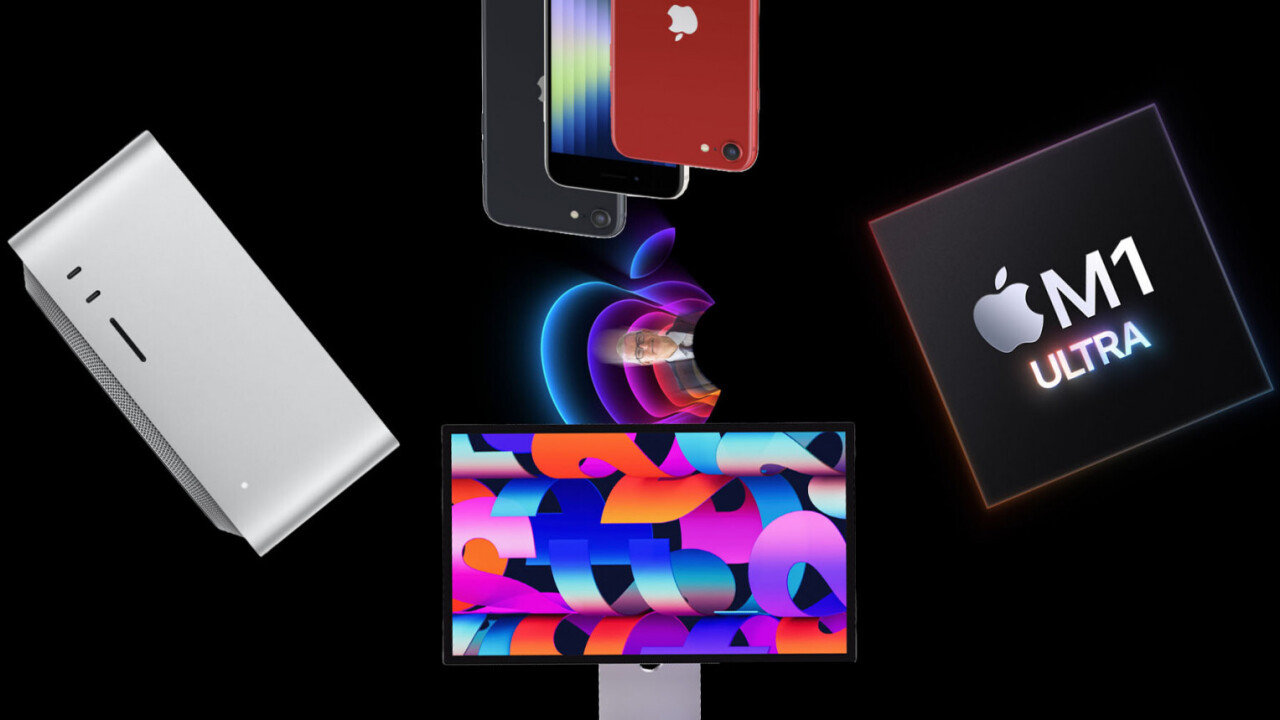
Everything Apple announced at its March 8 event

Everything Apple announced at its March 8 event

Everything Apple announced at its March 8 event 

Although it’s still using a dated iPhone 6-era design, the updated processor puts it on par with the best flagship phones for performance. Unlike many budget phones using mid-range and low-end processors, the iPhone SE should maintain decent performance for several years to come.


Apple event March 8

The phone is using a 12MP rear camera, but A15 bionic means it gets the latest computational photography techniques for better skin tones and improved low light performance. Apple also says the iPhone SE has improved battery life, although it didn’t specify how it compares to previous models or other iPhones.


The iPhone SE will retail for $429. Pre-orders open Friday and it will be available starting March 18.


An updated iPad Air with M1

Apple announced an update to the iPad Air, which was last refreshed in 2020. This time around it’s using the same M1 processor in the iPad Pro and MacBook Air. Apple says the device is 60% faster than the A14 chip in its predecessor, and 2x faster than the best-selling Windows laptop.


Apple event March 8

Apple has also updated the front-facing camera with 12MP ultra-wide optics, allowing it to use the Center Stage feature that automatically adjusts framing for more cinematic video calls.


The new iPad also supports 5G connectivity and 2x faster USB-C storage speeds. It comes in purple now too, which is neat. It will retail for $599, starting at 64 GB, and will be available on March 18. Pre-orders begin Friday.


M1 Ultra

Apple’s transition to its own desktop processors revolutionized performance on macOS — and made competitors step their game up. Today Apple announced the most powerful chip in the M1 family: the M1 Ultra.


M1 Ultra is essentially two M1 Maxes stuck together using a special interconnect technology dubbed “UltraFusion.” It features 114 billion transistors and 128GB of unified memory while maintaining “industry-leading” power efficiency.


Apple event March 8

In all, the chip has a 20-core CPU (16 high-performance and 4 high-efficiency), a 64-core GPU, and a 32-core neural engine, for performance 8x faster than M1. Apple also says the GPU is more powerful than the top-range discrete graphics on the market (presumably an Nvidia 3090, although Apple didn’t specify) while using 200W less power.


Of course, that will depend on optimization, as we saw with the M1 Pro and Max, but those chips were certainly no slouches. The M1 Ultra is set to be a beast in both CPU and GPU performance.


Mac Studio

Apple has long been rumored to be updating the Mac Mini with a more powerful variant, and that finally arrived today in the form of the Mac Studio.


Apple event March 8

It looks a lot like a chunkier Mac Mini. The svelte desktop computer uses M1 Max and the new M1 Ultra, offering beastly performance in such a tiny frame.


Design-wise, it has a footprint of just 7.7 inches squared, and a height of 3.7 inches. It offers four Thunderbolt 4 ports, two USB-A ports, a 10GB Ethernet port, an HDMI port. It also has two USB-C ports on the front (Thunderbolt 4 on the Ultra) and an SD card slot (!).


The introduction of M1 Ultra shatters performance compared to even the most expensive Mac Pro. Apple says M1 Ultra Studio offers 60 percent faster CPU performance than the top-of-the-line 28-core Intel Xeon Mac Pro. It also offers 80% faster graphics than the Radeon 6900X chip in the same maxed-out configuration.


Apple says it can even handle 18 streams of 8K ProRes 4:2:2 — something it claims no other PC in the world can do.


It’s a beast of a tiny computer, and I feel bad for anyone who recently bought a Mac Pro. The device starts at $1,999 with the M1 Max, and $3,999 with M1 Ultra. You can pre-order it now, and it will be available March 18.


Studio Display

Apple announced a new monitor to go along with the Mac Studio: the Studio Display.


Apple event March 8

It’s a powerful 27-inch monitor, with 5K Retina resolution, 600 nits of brightness, True Tone support, and an anti-reflective coating (a nanotexture glass option is available for further glare reduction).


The monitor also features a 12MP ultrawide camera with Center Stage support, as well as 6 speakers with support for Spatial Audio and Dolby Atmos. It even features an A13 Bionic chip to handle image processing as well.


As for connectivity, you get three 10Gbps USB-C ports, and one Thunderbolt 4 port that connects to your Mac and transmits up to 96W of power. There are two stand options available; the default option only supports tilt, while a more expensive stand includes tilt and height adjustment. There’s also support for VESA adapters if you want additional flexibility.


The Studio Display will be available on March 18 starting at $1,599. Thankfully, the default stand (or the VESA adapter) are included at that price. Pre-orders are open now.


A green iPhone 13 and iPhone 13 Pro

Apple event March 8

The iPhone 13 and 13 Pro now come in green. Nice.

I have a theory about why Apple won’t release another router

I have a theory about why Apple won’t release another router

I have a theory about why Apple won’t release another router 

Back in 2018, Apple bowed out of the networking game entirely and discontinued its AirPort and Time Capsule line-up.


Besides me, one who hasn’t let this slide is Bloomberg’s Mark Gurman. In a piece published earlier this week, the renowned Apple analyst and leaker called for the company to reintroduce Wi-Fi routers as part of its product portfolio.


And, honestly? The argument for this relaunch is compelling.


apple airport express first gen

This is the AirPort Express, which was both capable of AirPlay and being a wireless access point.

Effectively, Gurman argues that now Apple has finally pulled its head out of its arse with its Mac range (ergo, dropping irritations like the Touch Bar and the Butterfly Keyboard, while improving the MacBook Pro and introducing the M1 chip), the time is nigh for the company to take another look at networking.


There’s some sense in this by itself, but the aspect of Gurman’s reasoning that appealed to me most was the suggestion that Apple should develop a mesh system using its devices.


The company has already done something similar with its AirTags, as it uses a mesh of Apple devices to locate the trackers. In terms of providing a Wi-Fi signal in your home, the company could release an updated AirPort router that then connects to other Apple devices (like the HomePod Mini), creating a mesh network covering your whole house.


It’s a fantastic idea — but it’s not gonna happen.


Why won’t Apple release new routers?

There are two main reasons. Shockingly, let’s start with the first: technical limitations.


When Apple shuttered the AirPort range, it began retailing other companies’ routers as a replacement. For example, it’s currently selling a Linksys Velop mesh system with three units for $500.


Linksys Velop mesh system

This is a pic of the Linksys Velop, a mesh system that even looks a tiny bit ‘Apple.’

The point here is that mesh networking doesn’t come cheap. And if the company wants to get its beloved ‘Apple tax’ and deliver a comparable experience, the new AirPort units will be bum-clenchungly expensive.


This leads onto our next point. For the new AirPort router range to be worthwhile for the average user, they need to deliver something beyond what other companies are doing with their networking equipment.


The aforementioned idea of meshing Apple products gets us close — as will expected features like an improved setup experience — but we bump into another problem: there aren’t enough home-based devices to provide an attractive mesh option.


Using iPhones, iPads, and MacBooks as nodes would be too battery taxing (let alone unreliable, as they’re constantly moving). If we look to Google, a company thriving in this space, the reason its Nest Wi-Fi mesh network has been so successful is because people have widely adopted its smart home products, from the Nest Mini to the Home Max.


Apple simply doesn’t have this advantage.


Maybe if the business had released a HomePod with a screen, things would be different. Instead, the company knows most Apple users don’t have homes brimming with its smart speakers, so that avenue of using them to create a mesh network is currently off the cards.


As it can’t look to this for differentiation, Apple would need to search elsewhere — and this is where other technical limitations arise.


header image the homepod with a screen

BEHOLD, A HOMEPOD WITH A SCREEN! (We pay this artist a lot of money).

For all intents and purposes, the Cupertino firm shuttered its division responsible for routers all the way back in 2016. This means there’s a cavernous knowledge gap in the company and, although I believe Apple has the resources to bridge it, it’d take an extensive amount of time and money to not just catch up, but actually outstrip organizations whose entire business is networking.


Again, this is possible, but here’s where we encounter our second reason why Apple won’t release a new router any time soon: reputation.


A key element in Apple enticing so many people into its ecosystem is due to the strong positive feelings its devices endear. For example, how many times have you heard people say they use the company’s products because “they just work?”


This is by design.


Anyone who has ever used a defective or poorly designed piece of tech knows just how much daily rage you direct towards it. Currently, Apple has fine control over the way the majority of its devices work.


If there’s a bug with an iPhone, it can be fixed via an over-the-air software update. If there’s a flaw on a MacBook, you can take it into an Apple Store. These problems have a clear workflow.


The same isn’t true of a wireless network.


Consider the last two years of the pandemic. How many times did your home Wi-Fi network drop out or frustrate you? The variance in people’s homes and where they place routers has a huge impact on how well they perform.


Think of Wi-Fi like a printer. Although the technology has improved in leaps and bounds, the nature of their operation inevitably leads to mistakes.


So, if Apple re-enters the world of routers, it risks suffering reputation damage over something it can’t control. And, if people start losing faith in Apple, they stop buying so many of its devices. That means less money. And we all know how Apple feels about money.


These two issues (the amount of investment and potential reputational damage) will, in my mind, keep Apple from re-entering the router market any time soon. This doesn’t mean it won’t happen, but I’d expect the company to first invest in its smart home offerings before branching out into networking again.


Which is a shame. I still miss my AirPort Express — and I’m holding out hope that, one day, we see its like again.

Featured

[Featured][recentbylabel]

Featured

[Featured][recentbylabel]
Notification
You can earn more money by puclicker app link to download from here ===> puclicker.webnode.page
Done